For lawyers, paralegals,
and legal professionals.

Here’s what lawyers and paralegals need to know about artificial intelligence literacy.
Artificial intelligence has arrived in force, and it’s reshaping the world of work in unexpected ways. The legal industry isn’t immune to these changes, with forward-thinking firms adopting AI tools at a rapid pace. AI is increasingly helping lawyers and paralegals to draft documents faster, commit fewer errors, and generally accelerate the many administrative tasks that come with working in law. However, artificial intelligence products like ChatGPT and Google Gemini can also make mistakes, like hallucinating incorrect facts. That’s why it’s essential for AI users to understand how artificial intelligence works – and to develop strong AI literacy. Here’s what you should know about artificial intelligence literacy for legal professionals.
The world of law is one where facts matter a great deal, and where accuracy is paramount. Whether you’re a trial lawyer, a corporate lawyer, an estate planner, or a real estate conveyancer, every day you deal with documents that demand total accuracy of data.
While artificial intelligence can and does help to accelerate tasks like document production, using AI improperly can lead to problems like incorrect outputs, hallucinations, and citing nonexistent case law. Artificial intelligence platforms are far from perfect, and they’re often biased in their outputs. That’s why it’s essential for legal professionals who use AI to understand where AI excels and where it runs into walls.
In one 2024 instance (Zhang v. Chen, 2024 BCSC 285), a B.C. lawyer named Chong Ke was formally reprimanded for citing fake cases that ChatGPT had invented. In this particular case, Ke included two AI hallucinations in an application filed in December 2023 – ultimately, cases that were proven to be nonexistant. The judge in the case ordered Ke to personally bear certain costs incurred by opposing counsel in investigating the fictitious cases and directed her to review her other files for AI-generated citations.
While the above is a nightmare scenario for most lawyers, responsible and ethical AI use can still render a variety of benefits for legal professionals and firms.
AI literacy depends on a functional understanding of how artificial intelligence tools like large language models (LLMs) work. To become AI literate, you’ll want to make sure you understand how AI systems work, including how they use machine learning and natural language processing to create outputs.
AI systems can be contextualized over time. Well-designed prompts and frameworks can make outputs more consistent and useful for specific use cases.
One great way to improve AI output accuracy and usefulness is to give clear, detailed instructions to your preferred AI tool. If you’re using ChatGPT, for instance, you can instruct it to behave as a paralegal during document review and identify unclear language. Or, if you need to cite case law in a document, you can use an LLM like Google Gemini to flag potential citation formatting issues in your legal document.
According to Trilateral Research, large language models like ChatGPT have various limits. First and foremost, although LLMs like ChatGPT can generate remarkably fluent and contextually appropriate responses, they do not guarantee that those responses are facutally correct. ChatGPT and other LLMs can produce confident-sounding errors, including fabricated citations and other false information.
Artificial intelligence tools like ChatGPT also lack common sense. For instance, in 2023, New Zealand supermarket chain Pak ‘n’ Save created an artificial intelligence tool designed to help shoppers generate meal plans. While well-intentioned, this app inadvertently recommended the recipe for chlorine gas as a non-alcoholic beverage. Chlorine gas is a known poison that can damage one’s lungs or even cause death.
After this recipe went viral on social media, other New Zealand app users posted their results from the app; this recipe-building app had also created recipes for ant poison and glue sandwiches, French toast infused with turpentine, and a bleach mocktail.
Legal professionals must understand these limitations if they are to use AI. When using an LLM, always double-check its outputs for accuracy and appropriateness. For non-LLM artificial intelligence use, you’ll want to also provide adequate supervision to ensure your outputs are useful and correct.
Furthermore, legal professionals will want to ensure that the AI systems they use maintain client privacy and confidentiality. Always research your AI provider’s data-retention, security, confidentiality, and model-training practices, as well as the terms governing how submitted data may be processed and used. Firms should also establish clear policies governing what information may be entered into AI tools to ensure your data and client data remains secure and confidential.
Artificial intelligence tools like LLMs can render great efficiencies for legal professionals, helping to accelerate document drafting, improve the accuracy of contract review processes, and automate workflows. But AI can also pose risks to legal organizations that don’t understand how to use it responsibly. That’s why it’s essential for legal professionals to have a basic understanding of AI literacy – to mitigate risks and embrace efficiency.
You can get started on your AI literacy journey by taking AI literacy courses like those offered through law societies and legaltech providers. Clio, for instance, offers a free Legal AI Fundamentals Certification that covers the basics of responsible legal AI use. Alternatively, if you need a personalized AI literacy plan, your firm can hire an AI literacy consultancy to train your lawyers, paralegals, and support staff on responsible AI use.
While artificial intelligence can pose risks for legal professionals, the legal industry is still forging ahead with AI tools at a rapid pace – and that means failure to adopt AI tools could result in your firm getting left behind. But with a proper AI literacy plan, you can ensure your whole team understands artificial intelligence and can use it effectively and with minimal risk. The end result? Fewer errors, more revenue, and higher productivity.
AI can be intimidating if you’ve never used it before. That’s why Appara collaborated with AI expert Polly Allen to bring you the Utilizing AI Best Practices Guide for Modern Legal Professionals. Download your copy of this handy guide today to increase your AI literacy so you can cut costs and reduce errors in your legal practice.
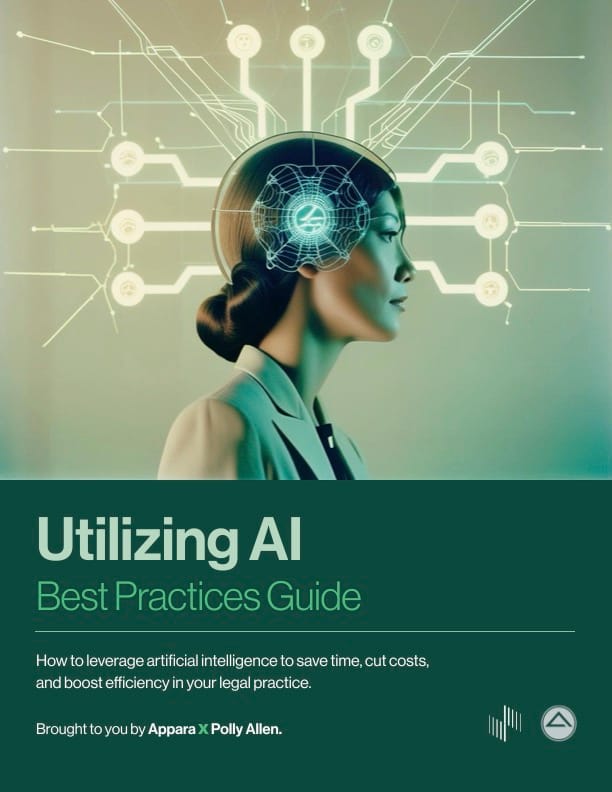
How to leverage artificial intelligence to save time, cut costs, and boost efficiency in your legal practice.
Brought to you by Appara X Polly Allen.
Engaging insights and the latest news, designed for legal professionals.